Safety features
Lynx implements multiple functions to enhance operational safety.
safetyopts parameter
This bitwise parameter controls the enabling/disabling of safety features.
/safetyopts
| Value | Name | Description |
|---|---|---|
| 1 | ACC NaN disarms forever | **Permanently** disarms when the accelerator input is invalid (NaN at /acc/asc/out). Without this setting, an invalid accelerator input still disarms but allows rearming once the input is valid again. /sig_acc itself reads 0 while disarmed. |
| 2 | Brake NaN disarms | Disarms from brake signal (sig_brake) if NaN |
| 4 | Brake NaN STOPs | Forces brake mode and prevents acceleration if sig_brake is NaN |
| 8 | No 0x5FF recovery | Prevents recovery from timeout on CAN msg 0x5FF |
| 16 | Disable 0x5FF timeout | **Disables timeout** on CAN msg 0x5FF |
Disarming Block
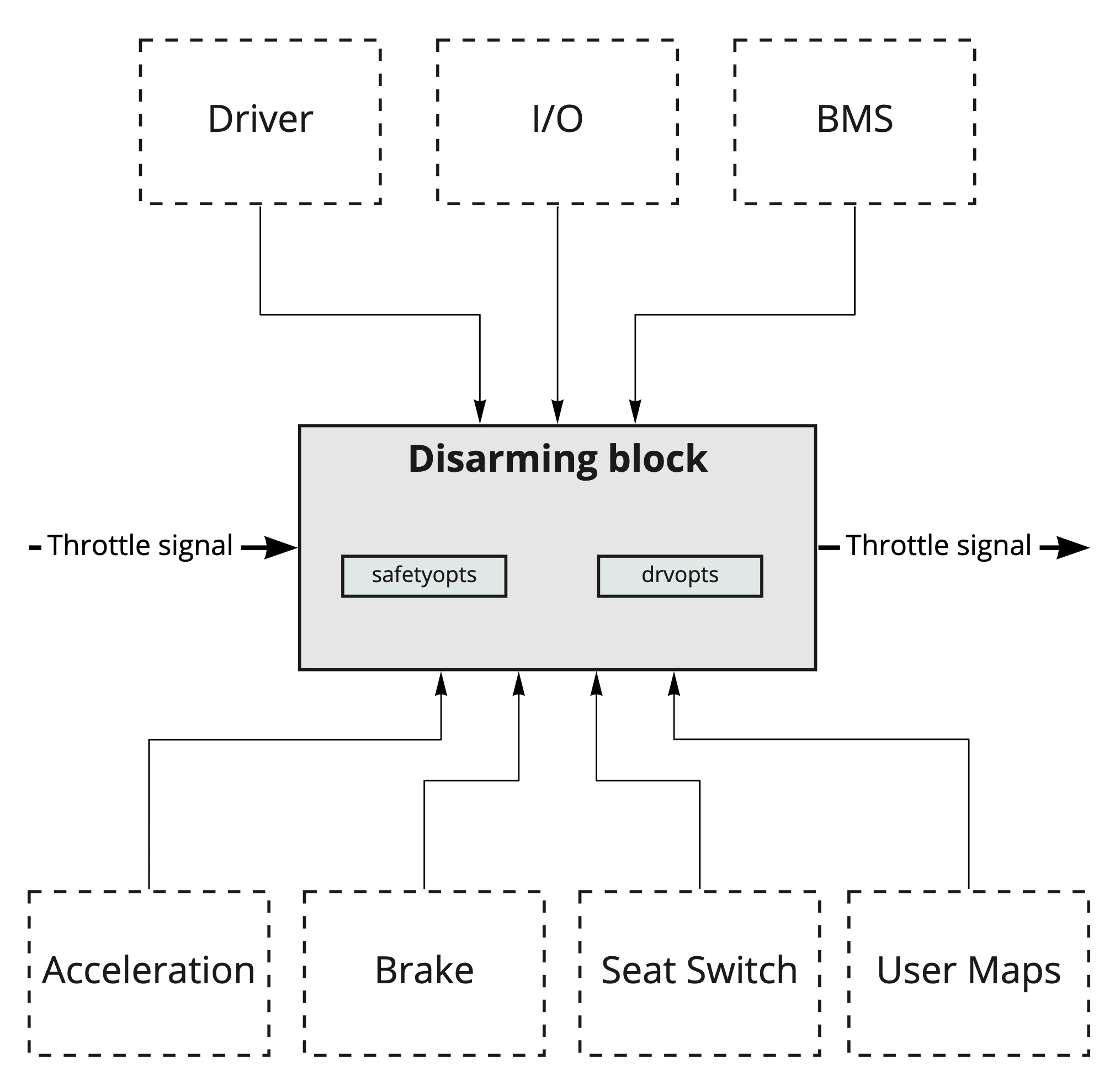
The built-in safety system monitors various inputs and can disable the accelerator signal path (before entering the driver) and cruise function when safety risks are detected. This ensures the motor won't accelerate from accelerator input and cruise remains deactivated during potential safety risks. The system structure is illustrated below.
Disarm Reasons
Various sources can trigger safety risk conditions, resulting in device disarming. The following list details potential sources:
- Positive values: Device will recover from disarm state
- Negative values: Device remains disarmed until reboot
disarm_reason value | Description |
|---|---|
| 0 | Device armed |
| 1 | Initial state after device boot |
| 2 | Accelerator input invalid (NaN at /acc/asc/out) |
| 10 | Seat switch activated |
| 11 | Reverse activation disarm |
| 12 | Map change disarm (mapopts&4) |
| 13 | BMS state disarm (undervoltage and others) |
| 14 | BMS charging indication |
| 15 | BMS error |
| 16 | Device shutdown in progress |
| 17 | Identrun in progress |
| 18 | Accelerator input invalid (NaN at /acc/asc/out) - permanent disarm (safetyopts value 1). Shown as -18: a negative value persists until reboot |
| 19 | Geofence message timeout |
| 20 | Geofence message disarm command |
| 21 | /mode was in a mode that blocks driving (error, power-up initialisation, BMS error or charging, invalid inputs, CAN timeout, identification); it stays until the device arms again |
| 23 | Step-up charging active |
| 24 | Device in slave configuration |
| 25 | Accelerator disarm braking (drvopts&128) |
| 26 | Brake signal (sig_brake) NaN (safetyopts&2) |
| 27 | Brake signal disarm !(drvopts&1) |
| 28 | Driver override |
| 29 | Device locked |
While most input reactions are hardcoded, the disarming block can be customized through the safetyopts, drvopts, and mapopts parameters.