D-axis excitation
This subsystem enables d-axis current control for other-than flux weakening purposes. Specifically, MTPA (Maximum Torque Per Ampere) is implemented.
- The following variables are located in the
/driver/dacfolder. - This page is related to the VECTOR algorithm only.
The MTPA, using the motor parameters, is trying to find the best value of the D-axis current to maximize the shaft torque for the given total stator current. This algorithm is suited usually for the IPM motors. The algorithm has to work with many constraints depicted below:
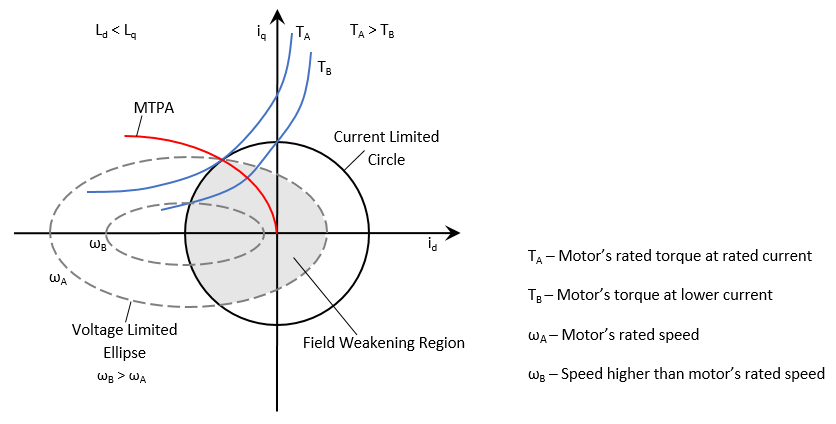
The optimal d-axis current depends on the difference between the d- and q-axis inductances. In a real motor this difference is not constant: it shrinks as the stator current rises (magnetic saturation), and the magnet flux also changes slightly with temperature. The controller compensates for the inductance drop using the non-linear motor model parameters Da and Dc. When these do not match reality, the resulting magnetizing current is sub-optimal, which is perceived as a variation of torque versus speed. The MTPA curve can therefore be shaped by adjusting Da, Dc, and mtk.
For the practical procedure of using these parameters to smooth a torque step around the high-speed transition on a real IPM motor, see the Driving an IPM motor guide.
The saturation (derating) model has been reworked:
- No more over-derating. Identified
Da/Dcvalues previously produced roughly twice the intended derating in the flux and MTPA calculations (a common workaround was keeping them at 0). From driver 6, the identified values apply correctly and can be used as-is. - Direction-aware d-axis. Demagnetizing d-current (field weakening, MTPA) now correctly increases the d-inductance as the iron de-saturates, instead of derating it further; magnetizing current derates as before.
Dcis for non-barrier rotors.Dccaptures the shared-iron cross-saturation: motors without rotor flux barriers (typically SPM) identify a realDc, which from driver 6 also saturates the q-inductance under load. Barrier-rotor motors (IPM) identifyDc≈ 0 and keep a constant q-inductance - correct for these machines. Always identifyDcrather than hand-tune it.
The result is a better MTPA optimum and more accurate torque estimates and torque-mode scales when Da/Dc are set. Configurations with Da = Dc = 0 (the previous common practice) behave exactly as before.
Parameters
dxc [.iref]
This parameter limits the maximum d-axis current for the other-than flux weakening purposes <0:disable>
Previously, this parameter was named
mtpa.
dxc is now the d-axis current limit and side-selector (positive = demagnetizing, negative = magnetizing), and the full MTPA trajectory is applied within that limit. If your PMSM was tuned with dxc < 1 on an older driver, expect a behavior change - re-verify the tuning. Setting dxc to the true MTPA d-fraction of the motor (0 for a surface PM) also unlocks the full low-speed torque in the torque modes.
mtk [-]
The MTPA feedback gain. The higher the value, the faster is the MTPA algorithm convergence. The lower the value, the smoother the response and lower the risks of oscillations. <0:direct map>
Together with the motor model parameters Da and Dc, this gain is one of the levers used to shape the MTPA curve.
Special value: 0 - disables the MTPA algorithm and forces
dxc*irefcurrent as the D-axis current reference.
(ESCx 5.0 and above) If the mtk value has a negative sign, the algorithm uses Q-current reference rather than actual measurement. This may yield into faster dynamics, but will work only in current control modes and may be problematic within saturation. Please contact siliXcon for further advice.
States (only esc5)
idref_dx [A]
The calculated d-axis excitation current reference.
torquef [Nm] (driver 6+)
Filtered estimate of the actual shaft torque, continuously maintained by the driver (filtered with the mtk constant).